I was going to show you pretty pictures, but Blogger has other ideas. Oh, the joys. So you'll have to make do with a mental image instead.
Imagine yourself crossing the 'big bridge', as they always put it in Gavin and Stacey (imagine yourself too, if you like, loving Gavin and Stacey for its frequent mentions of the A48, then you'll be in the right mood). Search in your pocket for the ridiculous quantity of change now required to entering the principality. Find the manned toll booth ('always use the one with the person in it' as my lovely pal Alex says, 'because that way you're keeping someone in a job').
And as you put your foot down on the accelerator and head towards the wingspan of the bridge, sing this as hard as you possibly, possibly, can:
Friday, August 20, 2010

Wednesday, August 11, 2010
Age shall, of course, wither us, but we'll continue in denial
I was at a wedding earlier this month with some of my favourite people, one of whom was (duh) getting married.
It was everything it needed to be. The wedding itself was gorgeous; sincere and lovely and just so HAPPY but loads of fun too (Depeche Mode to come back down the aisle to, anyone?).
Three-line-whip get-togethers of the whole gang are relatively rare nowadays, so there was a Mexican wave of a cheer every time the next familiar face arrived. And - maybe significantly in the context - the various offspring had all been left at home, so we were in utter party mode, and also, for twenty-four hours, able to pretend to be the irresponsible yoofs we'd once been.
'Forty?' said K.; blonde, beautiful and several years younger than us (married into the clan, and we're very glad of her). 'None of us are old enough for that to be happening. Forty's what...grown-ups....do'.
I don't know whether this is related to the one semi-coherent point Tony Parsons made, in Man and Boy, when he observed that our post-war generation hasn't had to work at anything so it doesn't know how to do anything but live in perpetual youth. Maybe that's part of it, but we looked around. Amongst the dozen or so of us, we'd experienced what's probably the normal amount of life stuff; serious illnesses, a couple of football-teams' worth of kids, redundancy, fertility issues. None of those things was tackled lightly, or could be anything other than adult in nature.
But K. was right. We still don't feel old enough.
It was everything it needed to be. The wedding itself was gorgeous; sincere and lovely and just so HAPPY but loads of fun too (Depeche Mode to come back down the aisle to, anyone?).
Three-line-whip get-togethers of the whole gang are relatively rare nowadays, so there was a Mexican wave of a cheer every time the next familiar face arrived. And - maybe significantly in the context - the various offspring had all been left at home, so we were in utter party mode, and also, for twenty-four hours, able to pretend to be the irresponsible yoofs we'd once been.
***
I was in the car today and looked up at the date, and thought, 'blimey, Tim's birthday tomorrow - is he 41 or 42 now?'. And then I remembered that, whilst I'll almost certainly associate the Glorious Twelfth with Tim, he's not around to have any more birthdays. It seems impossible, just impossible; perhaps all the more so because he was someone I didn't see much of recently, so I don't notice his absence on a daily basis the way I know others do. ***
Whilst I was thinking about this, and almost resenting the fact that we can be old enough to have friends who've died (and I know that I've just been extraordinarily lucky, really, to get to this age without bad shit happening before) I remembered something that one of our gang had said at the wedding. We'd been doing the usual, 'what's the next excuse for a party?'. Since most of us are married at this point (and happily, so second weddings aren't in the offing as the festivity-provider), it's likely to be the rash of fortieth birthdays that start for us next spring. 'Forty?' said K.; blonde, beautiful and several years younger than us (married into the clan, and we're very glad of her). 'None of us are old enough for that to be happening. Forty's what...grown-ups....do'.
I don't know whether this is related to the one semi-coherent point Tony Parsons made, in Man and Boy, when he observed that our post-war generation hasn't had to work at anything so it doesn't know how to do anything but live in perpetual youth. Maybe that's part of it, but we looked around. Amongst the dozen or so of us, we'd experienced what's probably the normal amount of life stuff; serious illnesses, a couple of football-teams' worth of kids, redundancy, fertility issues. None of those things was tackled lightly, or could be anything other than adult in nature.
But K. was right. We still don't feel old enough.
Monday, July 19, 2010
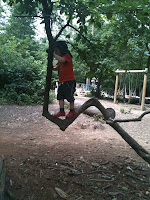
These are my trees: Didn't fall far
We went into Jonah's pre-school last week for his pre-Big School 'report'. He's lovely, they said. We know that, we said, but thank you; it's still good to hear from others.
My other favourite part of the report? Jonah's been taking part in a 10-week project called Forest School. Once a week, he and his classmates have spent the 'classroom' session outside, literally, in a forest, messing around with trees, learning to cook around a fire, making pictures with 'treasures' they find. At four I'd have adored it; at nearly 40, I think it's more or less compulsory for the soul.
.jpg)
.jpg) 'The trees', he said.
'The trees', he said.
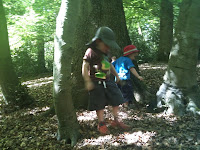
My other favourite part of the report? Jonah's been taking part in a 10-week project called Forest School. Once a week, he and his classmates have spent the 'classroom' session outside, literally, in a forest, messing around with trees, learning to cook around a fire, making pictures with 'treasures' they find. At four I'd have adored it; at nearly 40, I think it's more or less compulsory for the soul.
.jpg)
In preparing the report, Jonah's teachers asked him what he'd liked best about Forest School.
.jpg) 'The trees', he said.
'The trees', he said.
That's my boy.
Monday, July 12, 2010
That's me in the corner
Through happy chance, I've spoken to four of our Seattle friends in the last week. The time difference is a total bugger to negotiate, so it was particularly lovely to get to manage it so often.
The close proximity of the calls made me realise something, though, that I might not have noticed over a more separated period. I don't know how to speak American any more. The once-learned automatic cadences and re-accenting ('gar-arshhh' rather than 'garridge' for 'garage', 'fosset' rather than 'fawcet' for 'faucet' - and come to that, 'faucet' rather than 'tap') are gradually slipping away under first Irish and now British reassertion of dominance. Maybe I was always this inarticulate in the US and I've just sugar-coated my memories the way time allows, but I found myself tripping up on the absolute daftest of things; what the Americans say for 'ring road' ('arterial', I think; but I haven't looked it up so God only knows); whether it's a two-by-four or a four-by-two (and it's certainly not a 4X4, which is an SUV and thus something else altogether). It felt a bit like losing my religion. How could I not know how to speak anymore, for Christ's sake?
I've always been astonished by how little room in my brain there seems to be for vocabulary, especially for someone who loves talking so much. I learned Spanish for six months, and that was all it took for my 13 years of German (including two years living auf deutsch, um Gottes Willen) to be supplanted by those sneaky sibilant 's's and perkily phonetic phrases.
The exception to this (and why yes, I have spent a long time thinking about this; why do you ask?) is for words that I particularly attach to a given situation. 'Carafe' in French, because all wine is in jugs so you're forever asking for jugs. 'Strassenbahn' (or worse, the colloquial 'Binnen') for tram in we-will-rule-everything-on-little-electric-trains Germany. 'Remolque' in Spanish, mostly because I learned Spanish with Ol (yeah, this is what we did for fun. I know.) and the phrase 'Tienes uno remolque?' ('do you have a tow truck?') struck as the most ridiculously un-useful phrase ever from car-less central London. The 'learned it here first' rule also holds good for English, it seems; I was able to chat diapers and strollers with lovely Kim without the need of a translator.
Anyway, I hadn't thought about one of our forms of English drowning out the others. I'd assumed, if I considered it at all, that we'd switch effortlessly from one to the other the way we drive on the left or the right (or the middle, in Ireland, where the roads are so tiny and twisty) according to cultural dictat. But no. It would appear that even the mother tongue is situational.
The close proximity of the calls made me realise something, though, that I might not have noticed over a more separated period. I don't know how to speak American any more. The once-learned automatic cadences and re-accenting ('gar-arshhh' rather than 'garridge' for 'garage', 'fosset' rather than 'fawcet' for 'faucet' - and come to that, 'faucet' rather than 'tap') are gradually slipping away under first Irish and now British reassertion of dominance. Maybe I was always this inarticulate in the US and I've just sugar-coated my memories the way time allows, but I found myself tripping up on the absolute daftest of things; what the Americans say for 'ring road' ('arterial', I think; but I haven't looked it up so God only knows); whether it's a two-by-four or a four-by-two (and it's certainly not a 4X4, which is an SUV and thus something else altogether). It felt a bit like losing my religion. How could I not know how to speak anymore, for Christ's sake?
I've always been astonished by how little room in my brain there seems to be for vocabulary, especially for someone who loves talking so much. I learned Spanish for six months, and that was all it took for my 13 years of German (including two years living auf deutsch, um Gottes Willen) to be supplanted by those sneaky sibilant 's's and perkily phonetic phrases.
The exception to this (and why yes, I have spent a long time thinking about this; why do you ask?) is for words that I particularly attach to a given situation. 'Carafe' in French, because all wine is in jugs so you're forever asking for jugs. 'Strassenbahn' (or worse, the colloquial 'Binnen') for tram in we-will-rule-everything-on-little-electric-trains Germany. 'Remolque' in Spanish, mostly because I learned Spanish with Ol (yeah, this is what we did for fun. I know.) and the phrase 'Tienes uno remolque?' ('do you have a tow truck?') struck as the most ridiculously un-useful phrase ever from car-less central London. The 'learned it here first' rule also holds good for English, it seems; I was able to chat diapers and strollers with lovely Kim without the need of a translator.
Anyway, I hadn't thought about one of our forms of English drowning out the others. I'd assumed, if I considered it at all, that we'd switch effortlessly from one to the other the way we drive on the left or the right (or the middle, in Ireland, where the roads are so tiny and twisty) according to cultural dictat. But no. It would appear that even the mother tongue is situational.
Sunday, June 20, 2010
Queue here for the pink bricks
We spent today at LegoLand. It was Fathers' Day, and it seemed like an apt place to spend it, with one Lego-crazed boy and two Lego-crazed wannabees (when they can just figure out how to put it all together...). It was a great day, and we had a blast, but that's not what I'm here to talk about.
Before we got there, I'd taken the concept of LegoLand pretty literally. I thought it was going to be a centre of tiny (and not so tiny) Lego models, and maybe a few places where you got to put together your own pale imitations instead. But no...LegoLand, as anyone who actually bothers to read about where they're going before they go would have known, is essentially a mini theme park. There's Lego galore, bien sur; but there are also log flumes and pirate ships and dinosaur rides and Vikings and diggers and car tracks and....
....and absolutely nothing that seems aimed towards girls. I'm not advocating gender-based play; to be honest, having grown up in a two-daughter household with toy garages and Scalectrix, and having bought our boys a toy kitchen for Christmas two years ago, I actually think it doesn't really occur to me. But you see the evidence around enough to know that gender-based play does exist: that for every Captain Hook walking the plank there must be a mermaid combing her hair; for every bumper car there's a hospital with a nurse in attendance; for every dinosaur there's a...a what? Betty Flintstone? Buggered if I know.
Anyway, it just struck me as curious. The conclusion we came to was that Lego's self-selecting; whether meaning to or not, it appeals more to boys, thus the activities were centered around more typical 'boy' interests, too. I've got no idea whether this is actually true or not, but it was weird to be presented with such a strong gender-based theme park. Who knew those even existed? Or are theme parks, by their very nature, more 'male'? And no, I'm not bringing Dollywood into this.
Before we got there, I'd taken the concept of LegoLand pretty literally. I thought it was going to be a centre of tiny (and not so tiny) Lego models, and maybe a few places where you got to put together your own pale imitations instead. But no...LegoLand, as anyone who actually bothers to read about where they're going before they go would have known, is essentially a mini theme park. There's Lego galore, bien sur; but there are also log flumes and pirate ships and dinosaur rides and Vikings and diggers and car tracks and....
....and absolutely nothing that seems aimed towards girls. I'm not advocating gender-based play; to be honest, having grown up in a two-daughter household with toy garages and Scalectrix, and having bought our boys a toy kitchen for Christmas two years ago, I actually think it doesn't really occur to me. But you see the evidence around enough to know that gender-based play does exist: that for every Captain Hook walking the plank there must be a mermaid combing her hair; for every bumper car there's a hospital with a nurse in attendance; for every dinosaur there's a...a what? Betty Flintstone? Buggered if I know.
Anyway, it just struck me as curious. The conclusion we came to was that Lego's self-selecting; whether meaning to or not, it appeals more to boys, thus the activities were centered around more typical 'boy' interests, too. I've got no idea whether this is actually true or not, but it was weird to be presented with such a strong gender-based theme park. Who knew those even existed? Or are theme parks, by their very nature, more 'male'? And no, I'm not bringing Dollywood into this.
Saturday, June 12, 2010
And, of course, there's Camus...
I was all set to write about Martin Amis tonight, but the footie's on in the background, and my mind keeps filling with that instead.
I could give a damn about formations and the offside rule and all that technical nonsense; but I've always loved football for that huge sense of people joining together and willing something to happen. I suppose it's not the game itself I love - if you could get the same effect from a tiddlywinks championship, I'd be all over that instead, I'm sure - but the way it connects people's brains. And of course, in my brain, it makes me think of writers. Two in particular.
The first is, of course, Nick Hornby. I devoured Fever Pitch when it first came out and in those early days, before the onslaught of earnest contemporary male writers, the book was astonishing for showing you the world through the prism of the fanatic. As a non-fanatic with a great love of communication and my mates, there's a segment near the beginning that I remember any time there's a major match on. Arsenal have won some significant championship (she says vaguely; half our books are in storage at the mo and I'm pretty sure Fever Pitch is not one of the chosen few hundred currently on the shelves). Hornby describes coming home and his answer phone (this being pre-mobiles) is flashing like a streaker at a cricket match, full of messages from ex-girlfriends and distant relatives and his Mum; all these people who saw the result at the end of the news and were moved to call the biggest fan they knew.
I *love* that sport can bring connection like that. And Hornby, of course, put it beautifully; which is why the book went on to be such a huge success.
***
The second is Roddy Doyle, who wrote an essay about Ireland's participation in the 1990 World Cup for an anthology, The Beautiful Game. The whole thing is lovely, but then near the end, he's describing David O'Leary taking a penalty kick:
Doyle goes on to ponder, wistfully, that there's nothing in his profession that captures that same emotion. Apparently O'Leary's wife, at home in Ireland, had been unable to watch her husband's penalty, so she'd gone out into the garden and their son had come running out to tell her the result. I'm paraphrasing here, but Doyle's point is, imagine that happening at the end of a novel:
I could give a damn about formations and the offside rule and all that technical nonsense; but I've always loved football for that huge sense of people joining together and willing something to happen. I suppose it's not the game itself I love - if you could get the same effect from a tiddlywinks championship, I'd be all over that instead, I'm sure - but the way it connects people's brains. And of course, in my brain, it makes me think of writers. Two in particular.
The first is, of course, Nick Hornby. I devoured Fever Pitch when it first came out and in those early days, before the onslaught of earnest contemporary male writers, the book was astonishing for showing you the world through the prism of the fanatic. As a non-fanatic with a great love of communication and my mates, there's a segment near the beginning that I remember any time there's a major match on. Arsenal have won some significant championship (she says vaguely; half our books are in storage at the mo and I'm pretty sure Fever Pitch is not one of the chosen few hundred currently on the shelves). Hornby describes coming home and his answer phone (this being pre-mobiles) is flashing like a streaker at a cricket match, full of messages from ex-girlfriends and distant relatives and his Mum; all these people who saw the result at the end of the news and were moved to call the biggest fan they knew.
I *love* that sport can bring connection like that. And Hornby, of course, put it beautifully; which is why the book went on to be such a huge success.
***
'We had to score our last one....David O'Leary, a great player and a nice man...No one spoke. He placed the ball. It took him ages...the ball hit the net in a way that was gorgeous...I cried.'
Doyle goes on to ponder, wistfully, that there's nothing in his profession that captures that same emotion. Apparently O'Leary's wife, at home in Ireland, had been unable to watch her husband's penalty, so she'd gone out into the garden and their son had come running out to tell her the result. I'm paraphrasing here, but Doyle's point is, imagine that happening at the end of a novel:
'Ma, Ma! Da's after finishing the book!'
Friday, June 4, 2010
Say what?
Nearly three months have passed since we set sail* from the Emerald Isle; enough time to start to figure out what we've exported from our three years there. I've written before about wanting to hold onto our American positivity; with Ireland, what seems to have lasted is the language. Jonah, the only one of us to have ever truly passed as a native (despite his brother being the actual born-and-bred Gael), is starting to lose his Dub accent, which is both a shame and also a relief; it means he's hanging out with new buddies and absorbing their accents. A shame to be losing the accent, but a relief that he's not all alone in a corner of the classroom mourning his lost pals of the West.
Still, although an Irish accent isn't part of our family any more, it seems that certain words have crept in and are here to stay. I took the kids to buy new school shoes and runners last week; despite our best efforts, it's impossible to call the damn things 'trainers' when 'runners' is by far a more appropriate term for the footwear of a small boy.
Earlier this week, I had cause to teach Jonah when to use 'lashing' and when to use 'drizzling'; a distinction that made me giggle, because of course you'd need to know the word for a bloody great downpour in Ireland and a polite sniffle of rain in England. We're still inclined, as a family, to ask, 'Will I bring (the boys with me to the shop)?' rather than 'shall I take (the boys with me to the shop)?' Incremental differences, but they make me smile when I hear them. We seem to have slotted back into life in England with relatively few seams showing; but if you listen closely, the time overseas is there, embedded in our lexicon. Grand, so.
*oh, OK, it was RyanAir, but who the hell wants them in an opening sentence?
Still, although an Irish accent isn't part of our family any more, it seems that certain words have crept in and are here to stay. I took the kids to buy new school shoes and runners last week; despite our best efforts, it's impossible to call the damn things 'trainers' when 'runners' is by far a more appropriate term for the footwear of a small boy.
Earlier this week, I had cause to teach Jonah when to use 'lashing' and when to use 'drizzling'; a distinction that made me giggle, because of course you'd need to know the word for a bloody great downpour in Ireland and a polite sniffle of rain in England. We're still inclined, as a family, to ask, 'Will I bring (the boys with me to the shop)?' rather than 'shall I take (the boys with me to the shop)?' Incremental differences, but they make me smile when I hear them. We seem to have slotted back into life in England with relatively few seams showing; but if you listen closely, the time overseas is there, embedded in our lexicon. Grand, so.
*oh, OK, it was RyanAir, but who the hell wants them in an opening sentence?
Subscribe to:
Posts (Atom)
